
SESSION II: A Pattern Language


As part of an exercise for class, we were told to choose among a list of some great architecture books. The one I chose interested me a lot, since it was not an ordinary book. So much so, that many architects choose not to acknowledge it, while others make use of its solutions in almost every design. Such book in named Pattern Language, a 1977 classic, written by Christopher Alexander, among other contributors.
The book in itself is a guide. It provides problems and solutions for all types of people. These can range from people searching to remodel their homes, make simple home improvements, or ordinary people like you and me, who try to attain something from it. Surprisingly, it creates a new language or " a pattern language" derived from timeless entities called patterns. In total, there are 253, none of them strictly final. Actually, Alexander has a system in which some solutions are proved to be almost certain, and others are urged to be explored further.
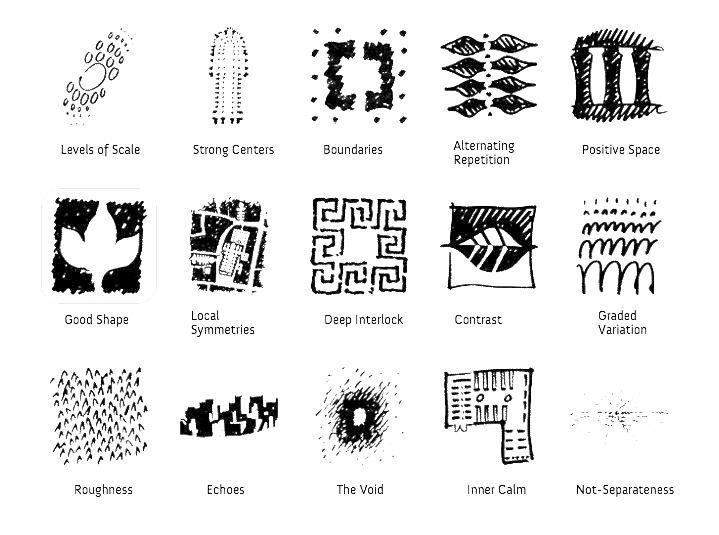
For some designers, the idea that everyone can design, just by following some rules is despicable. Such reason is due to the fact that rules are not to be taken so literally in a creative field of work. In my opinion, while not perfect, we should be able to drift apart from the rules now and then, but if there's something to learn from it as an "encyclopedia of knowledge", it shouldn't be depicted as such an awful book.

In the context of the book, the authors always introduces problems and solutions, from macro to microscopic scale. This comes across regarding residential, to city-wide planning solutions. It encourages us to always think and take into account the economy, culture, and structure of a place, in order to have a communal sense of responsibility.
Similar to Eames House, what I like about this book is that it creates a balance between human necessities and individual privacy. In addition, his design ideals are influenced greatly by art, literature, and psychology, crucial elements to affect the experience of any human in any space. In conclusion, this book is definitely worth a good read. Whether you agree with it or not, it provides some very useful solutions to real life problems. If it allows experienced designers, as well as ordinary people make great works, deemed to be looked at from an architectural stand-point it must be doing something right!
References:
- Alexander, C., Ishikawa, S., & Silverstein, M. (1977). A Pattern Language. Oxford University Press.


Comments