
SESSION IV: Charles Garnier's Opera House


Design itself has always been an evolutionary, never stationary career, as it takes on whatever predecessor it had and either improved or modified certain aspects. One could say, contemporary architecture is ever changing, yet that would be a false asseveration on the matter. What we do as architects, is merely take a stand or posture to react to the past with our our notions, points of views, and gestures.
We can see this through the use of more sculptured design, more minimal, perhaps through deconstructivism, etc. An example to this topic or statement, would be Charles Jenk's Opera House. It consists of its own impressive plans, axonometries, and cross- sections, but to get to the point it reached, he studied past's work's aesthetical attributes, structural, and historic context. This resulted in one of Europe's most visited, as well as iconic performance venues.
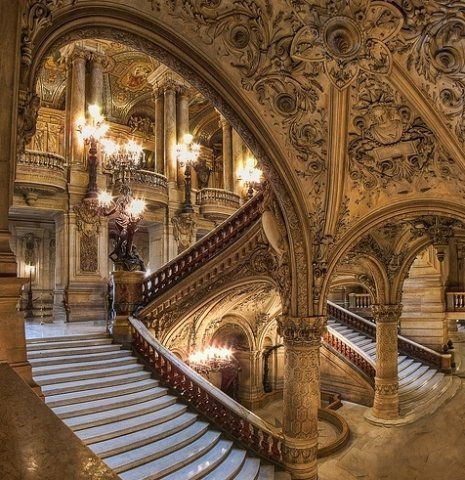
Its construction begun at 1860, after an explosion destroyed what the avenue was previously. Napoleon III chose to put it back in order, through Garnier who was selected through a competition among his peers. They all studied at a prestigious school called Ecole des Beaux- Arts, and wanted to be chosen in order to prove worthy of bringing this venue some much needed new life. The design Garnier brought to the table had great ornamental detail, statues, arches, columns crowned with arched pediments, and a huge dome for the audience.

It's style consisted of Baroque, with a Y-shaped grand staircase made out of marble. In addition it had an extensive foyer. Everything, from the ornate rows of seating, the majestic chandeliers, to Marc Changall's hand painted 1964 ceiling, just gave a greater sense of the majesty of the building. On another note, in order to really hold grasp of it, one needs to look at the building's cross-sections. The building is divided into several areas. These are: the main entrances, public areas, the stage, auditorium, and rehearsal and administrative areas. In addition, there's also a water reservoir underground, or a cistern.

For the building's context, we must look back at 19th century and neoclassical design. During this decade, revivalist movements such as Neo- Baroque and Neo-Renaissance, as well as exposed structural elements came about. This eclecticism is seen from the use of Greco-Roman arches, columns, and pediments, it's Palladian symmetry, and luxurious ornamentation. During this period of time it was common to have iron as a predominant material in the structure, and this for example was seen in the coming of the Eiffel Tower in Paris. Garnier, however chose not to flow into that movement, since he opted for a more "contemporary" look by not doing so.

Even though we were encouraged to study Garnier's Opera House, phenomenons like these are seen in every building. In almost any building, one must look back to understand a building's design ideals and decisions regardless of the location or scale. The study of chronological timelines is necessary to really comprehend the overlap between architecture and art movements. Analyzing examples like this Opera House, helps shed awareness , by accepting the darkness of this time, and the light of past eras.

References:
Agamben, G., & Kishik, D. (2009). What is The Contemporary? In What is an Apparatus? And Other Essays. Stanford, CA: Stanford University Press
Garnier Opera House. (n.d.). Retrieved September 06, 2020, from https://www.napoleon.org/en/magazine/places/garnier-opera-house/
L'Opera Garnier - Charles Garnier http://www.film-documentaire.fr/4DACTION/w_fiche_film/18951_1


Comments